As climate change continues to impact King County and the Pacific Northwest region, more communities are participating in water conservation. The City of North Bend is at the forefront of these efforts. The City pursues conservation in a variety of ways: through ongoing distribution system leak reduction efforts, environmental Wastewater Treatment Plant infrastructure upgrades, customer conservation education, watermain replacement, and what began in 2020, the Water Conservation Ordinance (WCO).
The WCO is a positive way to actively make a difference in water conservation. On April 16, 2024, the Washington State Department of Ecology declared a drought emergency due to the State’s water supply dipping to below 75 percent of what is considered normal. With warmer temperatures at higher elevations this spring, snowpack throughout the upper watershed of the Snoqualmie River melted faster than usual.
Beginning Thursday, August 15, Stage 1 of the City’s WCO will go into effect. The WCO pertains to all property owners inside City limits and all City of North Bend water customers inside or outside City limits. For some, this ordinance is an anticipated seasonal practice in our community, and for others, the WCO is new and as a participant, we understand new residents want to ensure they have all the information they need to join in water conservation efforts.
Your work to help conserve water and protect the Snoqualmie River are appreciated! Please read the full WCO by visiting www.northbendwa.gov/166/Water-Conservation and read more about Stage 1 below.
The intent of the WCO is conservation education and awareness, and it serves as a practice that benefits not only the North Bend community, but the Snoqualmie Valley as a whole.
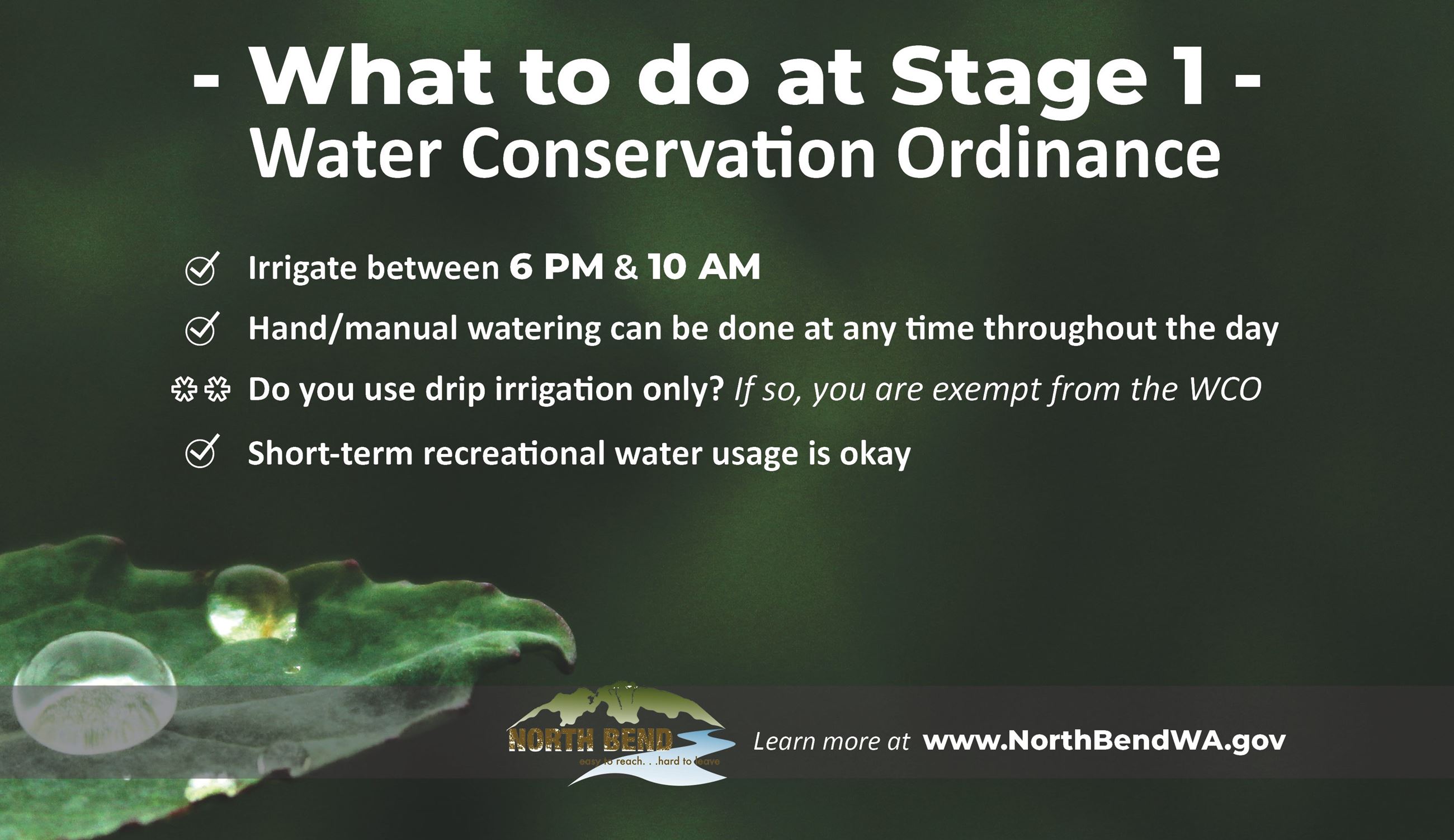
Irrigation during Stage 1: Irrigation is allowed from 6 p.m. to 10 a.m. every day during Stage 1. Irrigation includes yard, orchard, garden and other ornamental landscaping. During these times, less evaporation tends to occur, which is more water efficient and can reduce your water bill.
Hand/manual watering during Stage 1: During Stage 1, hand/manual watering is allowed any time throughout the day.
Drip irrigation systems as your sole source of watering: Properties with drip irrigation systems that are the sole source of watering are exempt from the WCO.
Playing in the water during Stage 1: Short-term recreational water usage is allowed under the WCO.
Examples of wasteful use of water under the WCO: Wasteful water usage occurs when water significantly runs off a resident's property, such as over irrigation, free flowing hoses, pool and pond draining and refilling (except as necessary for health, maintenance, or structural considerations), and washing concrete surfaces.
Is the City monitoring customer water usage and issuing fines for WCO violations? No. The intent of the WCO is conservation education and awareness. Police officers are not watching for mid-day watering. The goal is voluntary compliance. Penalties and citations would be issued only if initial contact and verbal violation warnings are ignored. The WCO directs the City to first have verbal or written contact with the party violating the ordinance. If violations continue, then the WCO directs the City to implement Step 2 and provide written notification, issuance of a notice to correct violation and enforce a penalty of up to $50 per day. Continued violations can result in Step 3, which provides for an administrative penalty of up to $200 per day.
When and if the City moves to subsequent stages of the WCO, a declaration will be made by the Public Works Director and residents will be notified via the City website and social media channels. Read helpful Frequently Asked Questions about the WCO HERE.